Minimally Invasive Office Procedures

Sinuplasty with Balloon Dilation
A balloon sinuplasty is a minimally invasive endoscopic procedure used to treat chronic sinusitis. Sinusitis is an inflammation of the lining within the paranasal sinuses. Once inflamed, the sinus cavities become a fertile ground for viruses, bacteria, and occasionally fungi to grow, resulting in infection. If it becomes chronic there may be a structural problem in the nose or sinuses. In those cases, a balloon sinuplasty may be recommended.
A balloon sinuplasty is a minimally invasive endoscopic procedure during which a thin balloon catheter is inserted into the nose. The balloon is gradually inflated to relieve blockages and widen the sinus pathways. The goal of a balloon sinuplasty is to enlarge the opening of the sinuses, reduce blockage and improve sinus drainage.
Benefits of Balloon Sinuplasty
Unlike traditional sinus surgery, balloon sinuplasty does not require incisions, or any removal of bone or tissue, although, in certain cases, it may be used in conjunction with traditional surgery. Balloon sinuplasty has many advantages over traditional procedures. Benefits may include:
- Absence of surgical incisions
- No damage to surrounding tissue
- Lack of serious complications
- Shorter recovery time
- Reduced bleeding
Although balloon sinuplasty is an effective treatment for relieving many sinus problems, and has no reported serious complications, it is not appropriate for everyone. Balloon sinuplasty cannot be performed on patients who have extensive scarring of the sinuses, ethmoid sinusitis or nasal polyps.
The Balloon Sinuplasty Procedure
A balloon sinuplasty may be performed in a hospital, ambulatory-surgery setting or doctor’s office. The procedure is commonly performed while the patient is sedated under general anesthesia but, in some cases, may be performed under local anesthetic. During the procedure, a sinus-illumination system with laser-tipped guides keeps the area well-lit so that the surgeon can see the site accurately. The physician inserts a guide catheter, that is attached to a wire and a small balloon, through the nostril and near the sinus opening. The balloon is inflated to expand the sinus opening. Another catheter, called an irrigation catheter, is then inserted to cleanse the sinus with a saline solution. After the opening of the affected sinus is cleared, the balloon is deflated and removed, but the sinus remains open. By gently reconfiguring the structure of the bones in the nose, the catheter restores normal sinus drainage, and keeps post-operative pain and bleeding to a minimum. Most patients can return home, the same day of the procedure.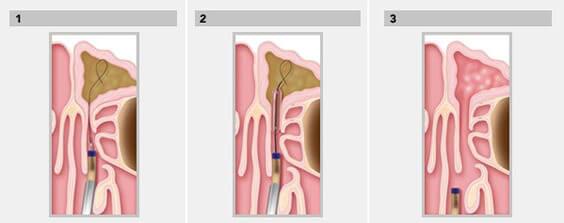
- Coastal ENT physician gently places a sinus guide catheter and a flexible sinus guidewire through the nostrils to access the target sinus. Next, a sinus balloon catheter advances over the sinus guidewire.
- The sinus balloon catheter is positioned across the blocked ostium and gently inflated.
- The Balloon Sinuplasty system is removed, leaving an open sinus passageway and restoring normal drainage and function.
Cryoablation with Clarifix
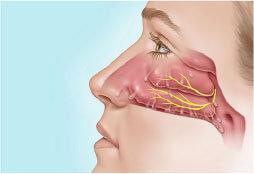
| Befor treatment: Overactive parasympathetic nerves |
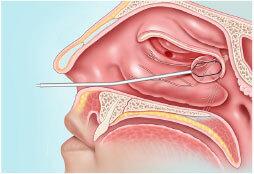
Treatment: In office procedure on with local anesthesia, the device freezes the bulk of the nerves at one point in to the nose. |
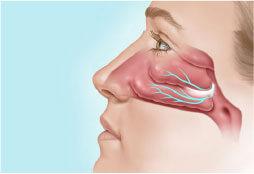
After treatment: Reduction in parasympathetic activity |
|
 |
 |
 |
|
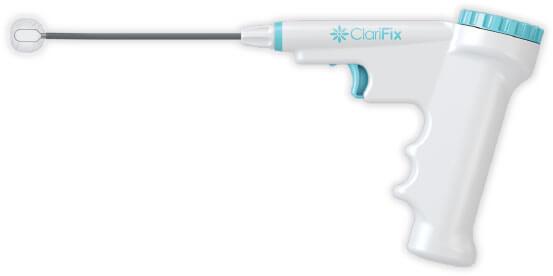
- Patients with out-of-balance nasal nerves suffer from chronic runny nose and post-nasal drip. If symptoms are refractory to allergy medications and ipratropium bromide spray, then cryotherapy can be a great option.
- ClariFix interrupts the nerve signals that tell the nose to drip, run, and swell which leads to decreased stuffy and runny nose symptoms.
- The treatment is performed in the office with only topical and local anesthesia. The ClariFix device and nasal camera is placed in the back of the nose where the out of balance nerves are located. The cold therapy is applied using a cooling probe and only takes a few minutes.
- After the procedure, there is only slight discomfort and a cooling sensation which resolves quickly. Most patients (80%) have an improvement in between 2-6 weeks from treatment.
Nasal Valve Repair with LATERA
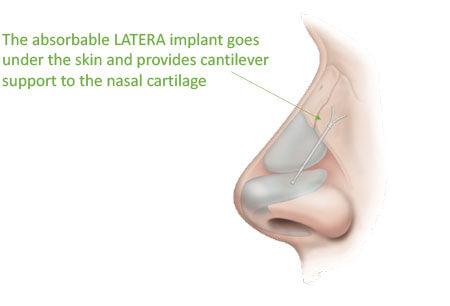
- The nasal valve is the region of the nose with the highest amount of nasal resistance. When the cartilage of the nose weakens due to trauma or chronic “sniffling” it needs to be supported to alleviate these symptoms.
- The LATERA nasal implant is used to support the upper and lower cartilage in the nose, reinforcing the nasal wall and reducing nasal obstruction symptoms so patients can breathe better.
- The LATERA implant is an alternative to conventional rhinoplasty to correct these issues and does so without changing the appearance of the nose.
- LATERA can be placed in the office with local anesthesia, requires minimal downtime, and is absorbable so you don’t have to worry about a foreign object staying in your nose!
- See our article on nasal valve collapse if you think you suffer from nasal valve obstruction and may be a candidate for this procedure.
Nasal Polyp Treatment with SINUVA
- Coastal Ear, Nose, and Throat offers a non-surgical procedure for patients who suffer from repeat nasal polyps with SINUVA™ (mometasone furoate) Sinus Implant. SINUVA is proven to reduce polyps and nasal congestion and obstruction.

- What is SINUVA?Coastal Ear, Nose, and Throat offers a non-surgical procedure for patients who suffer from repeat nasal polyps with SINUVA™ (mometasone furoate) Sinus Implant. SINUVA is proven to reduce polyps and nasal congestion and obstruction.
- How does SINUVA workIts innovative design provides a 2-in-1 approach: it is designed to open in the sinus cavity and release anti-inflammatory medicine to treat nasal polyps for up to 90 days.

Eustachian tube balloon dilation
 |
 |
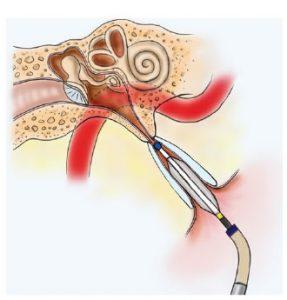 |
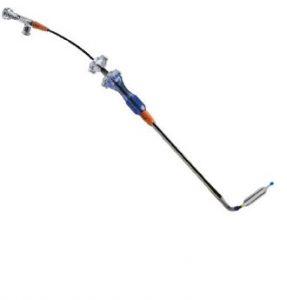
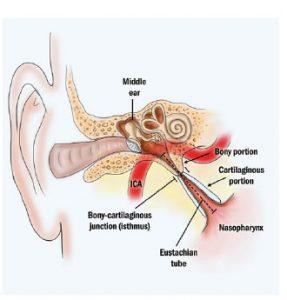
| Eustachian Tube Ballon | Obstructed Eustachian Tube | Eustachian Tube Balloon Dilation |
- Many patients with chronic sinusitis and nasal allergies also suffer from chronic ear fullness, pain, pressure and muffled hearing that occur due to Eustachian tube dysfunction. In this condition the ear tube becomes too narrow to function properly.
- The Eustachian tube functions to ventilate the ear and protect the middle ear from secretions. Normally the Eustachian tube is closed, but opens when we swallow, yawn, or chew.
- In patients who have chronic symptoms despite treatment of nasal conditions or pressure equalization tubes may be good candidates for Eustachian tube balloon dilation.
- A small balloon is inserted into the nose with a nasal camera. The balloon is specially made to fit seamlessly into the Eustachian tube, and when it is inflated the tube is dilated so it can function normally again.
- 56.1% of patients can expect improvement in quality of life, compared to 8.5% of patients with baseline medical therapy.
For refractory cases, there is a new minimally invasive office technique call Clarifix that can improve post-nasal drip in 80% of patients with refractory symptoms.
Nose & Sinus
 Septoplasty
- Balloon Sinus Surgery (Sinuplasty)
- Adenoid Hypertrophy
- Allergic and Chronic Rhinitis
- Pituitary Tumors
- Anosmia (Lack of Smell)
- Cerebral Spinal Fluid Leaks
- Nasal Fracture
- Nasal Obstruction
- Nasal Polyps
- Nosebleeds (epistaxis)
- Post Nasal Drip
- Sinusitis
- Minimally Invasive Office Procedures
- Tearing And Eye Surgery